Understanding Bridge Girder Fabrication in India: Standards & Best Practices
Understanding Bridge Girder Fabrication in India: Standards & Best Practices
Bridge girders form the structural backbone of bridges across Indian railways, highways, and urban infrastructure. They transfer loads from bridge decks to supporting piers while resisting dynamic loads, environmental stresses, and seismic forces. With 25+ years of experience on 100+ Indian bridge projects, here's what matters in quality bridge girder fabrication.
What Are Bridge Girders?
Bridge girders are large primary load-carrying beams designed per applicable codes:
- IS 800:2007: Code of Practice for General Construction in Steel (Indian standard)
- IRS Bridge Rules: For railway bridges (Indian Railways Specification)
- IRC 6:2017: For road bridges (Indian Roads Congress standard)
- AWS D1.5: Bridge Welding Code (widely adopted in India)
They must withstand:
- Sustained loads per design codes
- Dynamic impacts (traffic, trains at speed)
- Thermal cycling (India's monsoon season and seasonal temperature swings)
- Seismic forces (Himalayan, Deccan regions per IS 1893)
Types of Bridge Girders
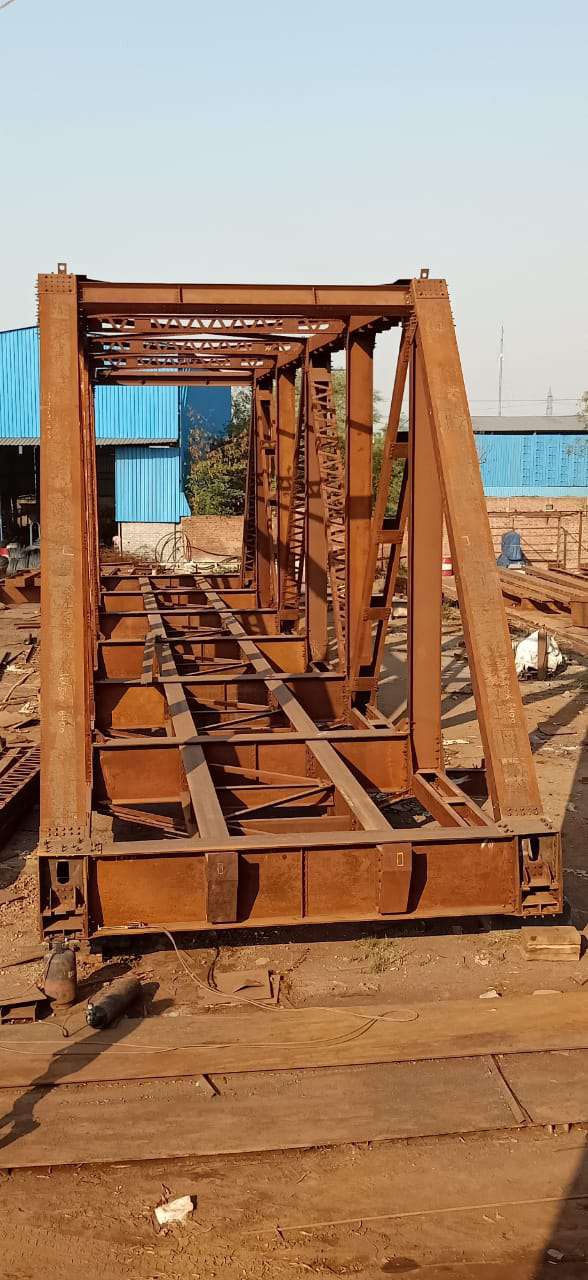
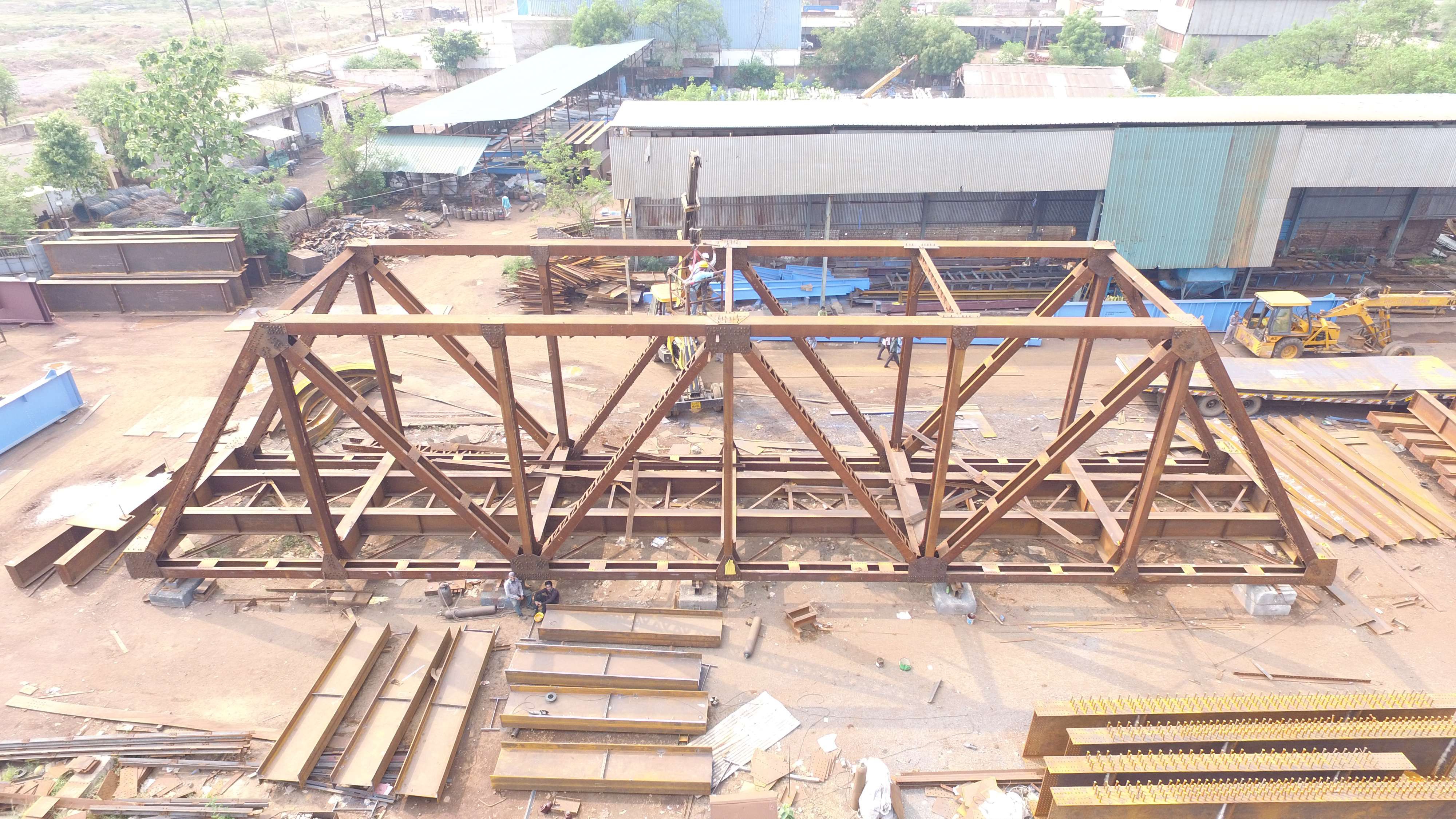
1. Plate Girders (Most Common in India)
Built-up sections welded from steel plates per IS 2062:2011 Grade E250 or E350. Typical spans: 20-50 meters for ROB (Road Over Bridges) and railway bridges across India.
2. Box Girders
Hollow rectangular sections increasingly used in urban grade separators and flyovers. Superior torsional rigidity per IS 800:2007 Section 3 design criteria.
3. I-Section Girders
Standard rolled sections (per IS 226 for Medium/Heavy sections) or built-up I-beams. Economical for shorter spans up to 30 meters.
Fabrication Process Per Indian Standards
Step 1: Material Selection & Verification
Steel Grade Specification:
- IS 2062:2011 Grade E250: 240 MPa yield strength (most common for bridges)
- IS 2062:2011 Grade E350: 350 MPa yield strength (for higher stress applications, ~12% cost premium)
- Each batch requires material test certificates (MTCs) confirming:
- Chemical composition per IS 2062 tables
- Mechanical properties (yield, tensile strength, elongation)
- Impact testing if specified (CVN at specified temperature)
Supplier verification: RDSO approved suppliers for railway projects, or third-party mill certification for other projects.
Step 2: Cutting & Preparation
CNC Flame Cutting per ISO 8501 standard:
- Tolerances: Per approved fabrication drawing and applicable code
- Edge quality: Smooth cut, no excessive drag marks
- Bevel preparation: Per IS 9595:2016 and AWS D1.5 for weld joint preparation
Step 3: Assembly & Tack Welding
Jig Assembly:
- Assembled on precision jigs to maintain dimensional requirements
- Tolerances per AWS D1.5 (for bridge fracture-critical members) or code requirement
- Tack welds: Sufficient to hold, will be incorporated into final weld
Step 4: Welding
Welding Procedure Specification (WPS): All welds per IS 9595:2016 and applicable bridge code:
- Submerged Arc Welding (SAW): For long seams (preferred for high-quality welds)
- Manual Arc Welding (SMAW): For intricate joints
- Low-hydrogen electrodes: E7015-H4 or equivalent (critical per AWS D1.5 bridge requirements)
Welder Qualification:
- Per IS 9595:2016 or ASME Section IX
- Re-qualification every 6 months per IS 9595
Step 5: Non-Destructive Testing (NDT)
Per Project Inspection & Test Plan (ITP) referencing applicable codes:
Ultrasonic Testing (UT):
- All complete joint penetration (CJP) groove welds per AWS D1.5 (bridge code)
- Acceptance per IS 7280:2015 (Code of Practice for Weld Testing and Inspection)
- Defect evaluation: Cracks = rejectable; porosity evaluated per code tables
Magnetic Particle Testing (MT):
- Surface/near-surface cracks per IS 7280:2015
- Heat-affected zone inspection for fracture-critical members
Visual Testing (VT):
- 100% visual per IS 9595:2016
- Weld profile, undercut, porosity, incomplete fusion evaluation
Radiographic Testing (RT):
- As specified in ITP (typically for critical joints on railway bridges per RDSO requirements)
Step 6: Surface Treatment
Shot Blasting:
- Standard: ISO 8501-1 Sa 2.5 (mill scale and rust removal)
- Surface roughness: 50-100 µm (Rz) per ISO 8501-1
Painting System:
- Per IS 9361:2011 (Specifications for Paint and Varnishes)
- Typical 3-coat system (primer + intermediate + topcoat)
- Design life per ISO 19840 corrosivity classification tables:
- C2 (mild urban/rural India): 15-20 years with maintenance
- C3 (industrial/coastal): 10-15 years with maintenance
Quality Standards Governing Indian Bridge Fabrication
- IS 800:2007: General steel construction code
- IS 2062:2011: Structural steel grades (E250, E350, and higher)
- IS 7280:2015: Weld testing and inspection
- IS 9595:2016: Design, fabrication, and erection of structural steelwork
- IS 1893:2016: Seismic design (for seismic-prone regions)
- IRS Bridge Rules: Indian Railways-specific requirements (mandatory for railway projects)
- IRC 6:2017: Indian Roads Congress standard for road bridges
- RDSO Specifications: Rail India Technical Specifications (government standard for railway components)
- AWS D1.5: Bridge Welding Code (internationally adopted, used in many Indian projects)
Why Select Certified Fabricators?
Technical Capability
- Facility meeting code requirements (adequate space, cranes, precision equipment)
- Equipment per IS 9595 (CNC cutting, welding machines, NDT tools)
- Capacity matching project throughput
Quality Systems
- ISO 9001:2015 certification (demonstrates systematic QMS per international standard)
- RDSO Approval (government approval for railway components; mandatory for IR projects)
- In-house IS 7280:2015 compliant NDT testing (UT, MT, PT capability)
- Calibrated equipment (traceable to national standards)
Experience & References
- Portfolio of similar bridge projects (railway, road, urban)
- BHEL, L&T, Tata Power, or SAIL references (major clients in India)
- Zero structural failures in track record
Common Challenges & Solutions
Challenge 1: Dimensional Accuracy on Large Girders
Problem: Welding distortion on 30-meter girders during multi-pass welding
Solution Per AWS D1.5 & IS 9595:
- Precision jigs and fixtures maintaining shape during welding
- Welding sequence designed to minimize distortion (back-step, balanced heating)
- Tolerances per approved drawing, verified via total station surveys post-fabrication
Challenge 2: Welding Quality for Fracture-Critical Members
Problem: Subsurface defects in bridge welds (required for safety per AWS D1.5)
Solution:
- Low-hydrogen electrode requirement (E7015-H4 or equivalent) per AWS D1.5
- 100% visual inspection per IS 9595
- UT or RT per ITP based on bridge code (AWS D1.5 specifies 100% UT for CJP welds in tension)
- Certified welders only (re-qualified every 6 months per IS 9595)
Challenge 3: Transportation Across Indian Infrastructure
Problem: Logistics of moving 30+ meter girders across Indian highways and railway corridors
Solution:
- Coordination with state transport authority for permits
- Route planning (clearance for bridges, power lines, railway ROW)
- Specialized transport contractors (heavy-haul specialists)
- Temporary supports and rigging design
Cost Factors
Bridge girder fabrication cost depends on:
- Span length and load: Longer spans = thicker plates, higher grade steel (E250 vs. E350 = ~12% cost difference)
- Material grade: E350 more expensive than E250 but allows thinner sections
- Surface treatment: Coating system complexity (basic 2-coat vs. high-performance 3-4 coat systems)
- NDT requirement: Project code (AWS D1.5 requires 100% UT = higher testing cost vs. D1.1)
- Logistics: Transportation distance within India varies cost significantly (₹5,000-15,000 per truck per 100 km typical)
- Schedule: Accelerated fabrication adds 15-25% cost (premium labor, overtime)
Regulatory Approvals Required in India
RDSO Approval (Railway projects):
- 3-6 month review process
- Mandatory for Indian Railways, DMRC, other PSU railway projects
IRC Approval (National Highway projects):
- Sometimes required; consult structural engineer
State-level Approvals:
- Some states (UP, MP, etc.) require additional fabrication facility certification
Labour Department:
- Structural safety certificate for fabrication facility
Future of Indian Bridge Fabrication
- Increased use of higher-strength steel (E350, E450) to reduce weight and cost
- BIM (Building Information Modeling) integration for complex urban flyover projects
- Modular fabrication techniques reducing field welding (safer, faster erection)
- Adoption of automated welding systems (higher quality, consistent welds)
- Focus on corrosion protection suited to Indian coastal/industrial environments
Conclusion
Quality bridge girders per IS 800, IS 2062, IS 9595, and applicable bridge codes (IRS/IRC/AWS D1.5) ensure safe, durable infrastructure with design lives of 80-120 years. Systematic fabrication per documented procedures, rigorous NDT inspection per IS 7280, and quality management systems (ISO 9001) distinguish excellent fabricators from average ones.
Planning a bridge girder package
Compare the girder type, span and inspection requirements with the work shown in our bridge and railway project references. For railway tenders, see the RDSO compliance dossier for the published registration scope, manufacturing units and inspection capabilities. Before issuing the enquiry, confirm the drawing revision, applicable standards and inspection plan, then send the package for a fabrication review.
Keywords: Bridge girder fabrication India, IS 2062 E250 E350, IRS railway bridge standards, IRC 6 road bridge code, AWS D1.5 bridge welding, RDSO approved fabricator, Indian bridge fabrication, IS 800 IS 9595
About Engineering Team
The Engineering Team at Kothari Chemicals Engineering Division brings decades of combined experience in steel fabrication, quality assurance, and project management. We're committed to sharing knowledge that helps our industry grow.